It’s Fair Time!! The lure of the CNE never gets old
By Lorie Steiner
The Canadian National Exhibition, the CNE, “the Ex” – whatever you wish to call it, this is one memorable event! For 18 days in late August until Labour Day, the CNE continues to beckon. What began as a busy agricultural affair back in 1879 still holds its beloved allure after more than 140 years. So what’s the secret? Memories, my friends. Wild and wonderful summer memories of Toronto’s lakeshore extravaganza weaving their way down through the generations.
I remember going to the Ex in 1972 in my early teens. Sonny & Cher were headlining at the CNE Grandstand – my first live concert. Groovy! That was the highest point of an entire day filled with high points. The sights, the sounds, the smells, the tastes, the people, the Midway… sensory overload in the coolest way.
Colourful costumes and pageantry sharing the beautiful culture of countries from around the world. Stunning floral displays, impressive art and needlework and amazing fruit and veg offerings vying for ‘best in show’ prizes. While all manner of domestic animals put on a good show to capture that elusive blue ribbon.
Did I mention food? The FOOD Building was always a major attraction. After all, you work up an appetite with so much to see and do! Pizza, pogos, burgers, exotic dishes, spicy dishes, fried everything and candy – candy floss, candy apples, penny candy… sticky fingers and smiling faces. Some things never change.
Whether it’s a 19th-century posed group photo, 1970s polaroid (look at those hot pants!) or last year’s smartphone selfie, the fun of looking back just never ends. So let’s explore a snapshot of CNE history!
A mosaic of Canadian heritage
Founded in 1879 as the Toronto Industrial Exhibition, the CNE has evolved as a beacon of national pride and one of the most renowned agricultural fairs in North America. Since its inception, people have come to the CNE to discover the latest innovations in technology and commercial products, to ‘rock out’ or sing along with popular entertainers and celebrate the joys of Canada. History buffs are wowed by the diverse architectural building styles. Members of the British Royal Family, Canadian Prime Ministers and celebrities of all kinds have visited the Ex over the years – and a good time was had by all.
When the CNE was closed during World War II, the fair grounds played an important role as a training and recruitment centre for Canadian troops, and in 1942 /’43, Patty Conklin of Conklin Shows, the CNE’s midway provider, took the Carnival to Toronto’s Riverdale Park as “The Fair for Britain” to keep spirits up.
Many iconic buildings and structures have, sadly, come and gone over the years. But a wealth of photographs, many in the CNE heritage archives, ensure that they aren’t completely lost.
“Meet me at the Fountain”
The stately Gooderham Fountain, constructed in 1911, was a monument to wealthy industrialist William Gooderham who, along with his brother-in-law James Worts, established the Gooderham and Worts distillery in 1837. The fountain was constructed on the “Grand Plaza of Exhibition City” between the Horticulture Building, the Graphic Art Building and the Administrative Building and became famous as a gathering place, inspiring the phrase “meet me at the fountain.” In 1958, the Gooderham Fountain was replaced by the Princess Margaret Fountain – located about 100 feet south of the original water feature.
The Graphic Art & Photography Building
In 1902, the Exhibition constructed its first building devoted entirely to showcasing fine art. Designed in the classical Greek style by architect Beaumont Jarvis, the interior’s deep crimson walls created a beautiful backdrop for works of art by world-famous artists. Newspapers of the time reported: “The Art Building… long desired and much-dreamed-of [has] at last taken shape in this thing of beauty. For, compare it with what you may – it will hold its own, in simplicity of design, purity of colour, and charm of proportion.” (The Star, Sept 2, 1902). A bigger Art Building was built in 1905 and the original one was repurposed for Graphic Art & Photography, where international photo exhibits were shown until the building was demolished in 1955.
A Royal Welcome
The Princes’ Gates were designed in the decorative Beaux-Arts style by the architectural firm of Chapman and Oxley as a majestic entrance to unite the CNE with the City of Toronto. Coinciding with the visit of Prince Edward and Prince George to the CNE in 1927, the grand entryway was named the Princes’ Gates to honour the royal brothers. Prince Edward cut the purple ribbon with gold scissors to officially open the Princes’ Gates on August 30, 1927.
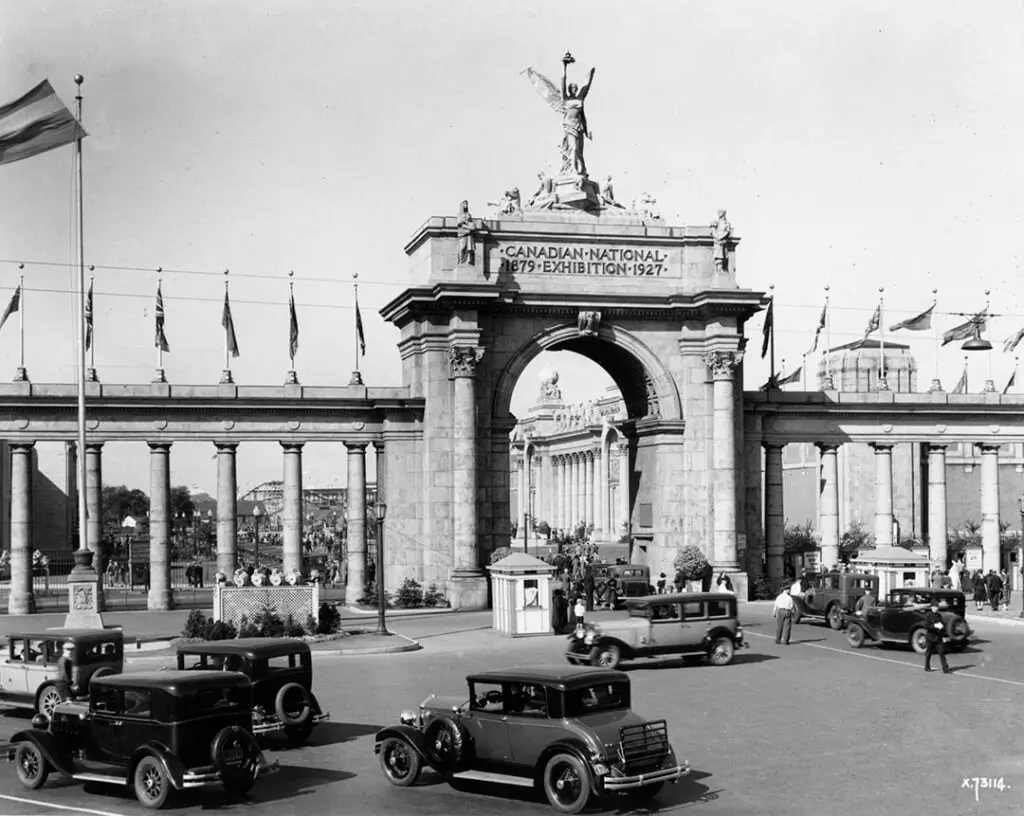
Above the Princes’ Gates, the Winged Victory holds a single maple leaf to symbolize Canadian independence and guide the CNE and Canada into the future. On either side of the sculpture are two pairs of identical figures. One pair holds cornucopias, representing the fruits of the harvest. The other holds beehives, representing hard work and prosperity. The sculptures on the pylons are also symbolic. The female figure with a sheaf of grain represents farming, while the male figure represents industry. Sculptor Charles D. McKenchie created all the figures adorning the Princes’ Gates.
Come along for the ride!
In 1890, Chicago beat out competitors to host the 1893 World’s Columbian Exposition, a celebration of the 400th anniversary of Christopher Columbus’s discovery of the Americas – and a serious challenge for fair organizers to outdo the Paris Exposition and its world-famous Eiffel Tower. The team was tasked to come up with “something novel, original, daring and unique.”
That’s just what George Washington Gale Ferris Jr. did. The 33-year old civil engineer from Pittsburgh sketched his idea out on a napkin: a huge revolving steel wheel to lift people up to the same height as the recently opened Statue of Liberty (1886). After investing $25,000 of his own money and securing an impressive $400,000 from investors, George Ferris’s wheel was chosen as Chicago’s answer to the Eiffel Tower. Measuring 250 feet in diameter and 264 feet high, the Ferris Wheel carried 36 cars, each capable of holding 60 passengers.
When it launched on June 21, 1893, the Ferris Wheel was touted as the “eighth wonder of the world.” During the Chicago Exposition, more than 1.4 million people paid 50 cents for a 20-minute ride and an aerial view second to none. The Ferris Wheel legacy continues today in carnivals, fairs and amusement parks worldwide – including the CNE!
Thrills & Chills
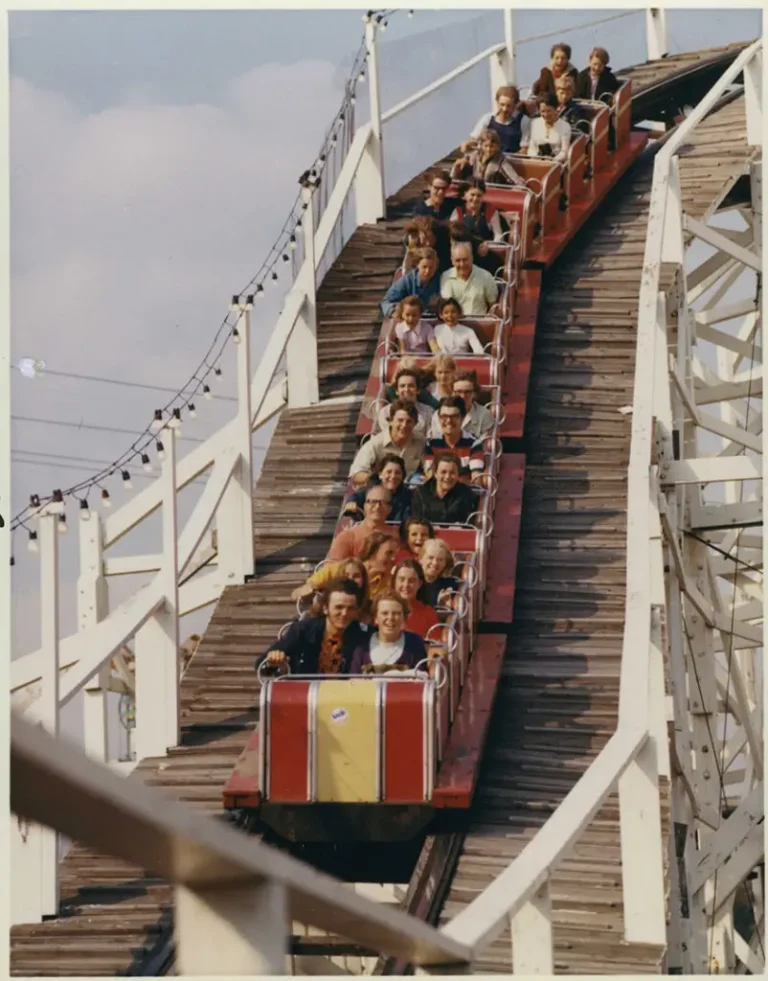
In 1953, the official CNE programme boasted “Thrills Galore” with the ‘new’ Flyer rollercoaster, billed as the “fastest Flyer in the world.” Reaching speeds up to 65 miles per hour, this second CNE rollercoaster named the Flyer justified its hefty construction price tag of $200,000 by becoming a superstar of the Midway at 2612 feet long and 62 feet tall.
On prime visitor days, more than 26,000 people rode the coaster, screaming and loving it the whole way. During 39 years of operation, well over nine million passengers took the white knuckle journey, holding on for dear life. Can you feel it? In the end, newer and faster rides took over in popularity and the Flyer was retired. The aging wooden structure was demolished in June 1992 but the memories live on.
So, are you ready for your ‘EX’cellent adventure? You’ll be in good company, joining more than a million visitors a year at this much-loved summer funfest. The CNE takes pride in celebrating the rich diversity of Toronto and the GTA and welcomes everyone with the invitation: “Let’s go to the Ex, oh baby!” theex.com