Nunavik, Quebec’s Far North
Explore the Unforgettable Arctic Frontier
By Lorie Steiner
Claiming a vast and unique presence above the 55th parallel, Nunavik covers over 507,000 km2 in Quebec’s Far North and is legendary for its beauty and the hospitality of the Inuit people who live there. Most of the region’s 14 villages are coastal communities, ranging from around 200 residents in Aupaluk to more than 2,500 in Kuujjuaq, the region’s administrative hub. In all, just over 14,000 people call Nunavik “home” and they’re waiting to welcome you with open arms.
Cheerful and friendly, the Inuit love to share their distinctive culture and linguistic heritage, art and stories, as well as the making of traditional clothing and tools. Living in harmony with nature is ingrained in the Inuit way of life; their age-old knowledge of animals, and the importance of conserving and protecting the Nunavik environment remain at the heart of their existence.
When you travel to this authentic, unspoiled northern land, you’re in for a memorable, magical getaway. Autumn is an especially beautiful time to visit, with plenty to do – night and day – before the winter solstice settles in to chill the landscape.
Seasonal splendour
With summer waning and the crimson and golds of autumn ready to blaze, Quebec’s Far North has a treat in store for travellers!
Every fall, from September to mid-October, Nunavik welcomes visitors with a fanfare of colours. In the villages south of the tree line, the larch trees of the boreal forest infuse the landscape with a panorama of brilliant yellow. It’s also the perfect time for berry picking, with a profusion of wild blueberries, blackberries, cloud berries and bright red lingonberries on the menu – a feast for the eyes and the tummy.
At night, another colourful palette appears as the Northern Lights paint the sky. Temperatures drop as winter approaches, but it’s a dry climate, so it doesn’t feel as cold as damper regions. Layers of warm clothing will do the trick nicely for your autumn escape.
Winter brings snow and ice as far as the eye can see. Snowsport enthusiasts will be in their element with Inuit-guided dogsled and snowmobile excursions, as well as cross-country skiing and snowshoeing.
Springtime arrives in Nunavik in stages, from the end of March in the southernmost part of the region to mid-June in the northern areas. From Kuujjuaraapik all the way to Ivujivik, white snowscapes slowly melt away – only to be replaced in summer by a carpet of green lichen and the delightful aroma of renewal across the land.
Summer is a short but mild season, when night never completely falls over the tundra. It’s perfect for long hiking, biking, canoeing or kayaking excursions. Nunavik boasts four outstanding national parks where you’ll be able to do just that in spectacular scenery, whether around a meteoric crater, amongst the highest peaks of Quebec, down majestic rivers or on inland seas surrounded by striking cuestas. nunavikparks.ca/en
Nature’s Northern Light Show
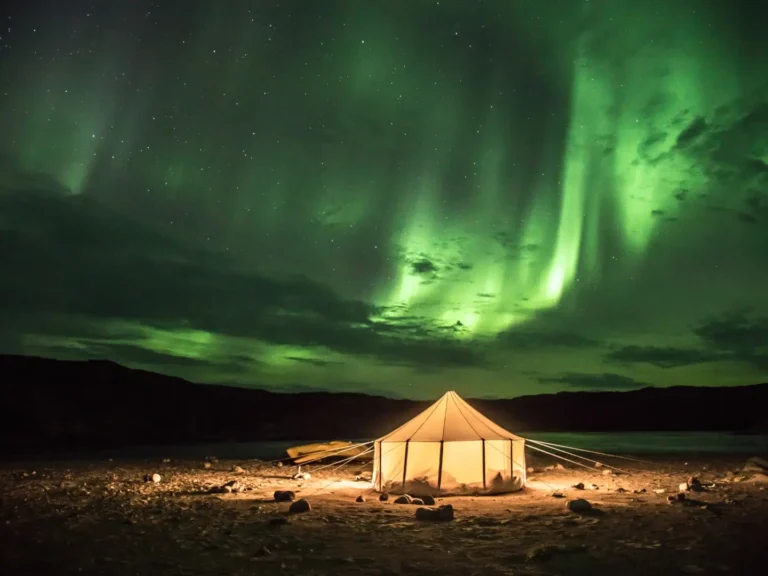
From its location on the aurora belt, Kuujjuaq is an ideal spot to experience the aurora borealis in all its splendour, and Inuit Adventures (aventuresinuit.ca/en) offers front-row views of enchanting Northern Lights performances. Or for the true adventurer, just imagine spending the night out on the tundra in an igloo built by your Inuit guides, mesmerized by the spectacle in the dark sky.
Lasting on average from a few seconds up to 45 minutes, no display is ever the same. Depending on solar activity, the aurora borealis can portray an arch spanning up to 1000 km, a strip, a curtain, a veil, a wreath or a pillar with rays up to 100 km high. Prime time for viewing the Northern Lights in Nunavik is from September to March, when darkness falls earlier and there are more hours to observe this natural wonder.
Experienced and novice photographers alike are thrilled with the opportunity to capture amazing shots of the bewitching aurora borealis. Taking a selfie with a smartphone and the ‘lights’ in the background is a keepsake, for sure.
Adventures in the wild
Being able to watch animals in their native northern habitat is one of Nunavik’s most unforgettable experiences. You may have sightings of a polar bear, or herds of caribou, the indomitable musk ox, tundra wolves, Arctic fox – not to mention an exceptional variety of marine mammals and migratory birds. Learn more about Nunavik’s Inuit-guided Arctic wildlife viewing experiences in HORIZON’s June 2025 issue.
Getting there
Nunavik is proud of its identity as a unique, diverse land with a rich Inuit heritage. Not connected to the province of Quebec’s road network, the region is only accessible by plane. But it’s a short flight, only two hours. Air Inuit provides the service with a daily jet flight from Montreal to Kuujjuaq – the gateway to Nunavik. Canadian North also offers the connection once a week on Saturdays from Ottawa.
Accommodation is available at established small inns and hotels in all of the region’s picturesque villages. Local outfitters and tour operators offer a range of fishing, outdoor adventure and ecotourism packages, often including observation of the Arctic wildlife, as well as cultural activities.
The Nunavik Tourism Association is well versed in trip planning to ensure your visit to Quebec’s Far North is one you’ll never forget! Reach out to them at nunavik-tourism.com.
Instead of thinking south this year, why not expand your horizons northward? The people of Nunavik look forward to showing you the sights and sharing their unique way of life.