Fire Up the Bar-B!
By Lorie Steiner
Summer’s here and so is BBQ season! But do you really know what that means? If you’re under the misconception that lighting the gas element on your outdoor cooker or changing the propane canister means you’re ready to barbeque, you’d better read on…
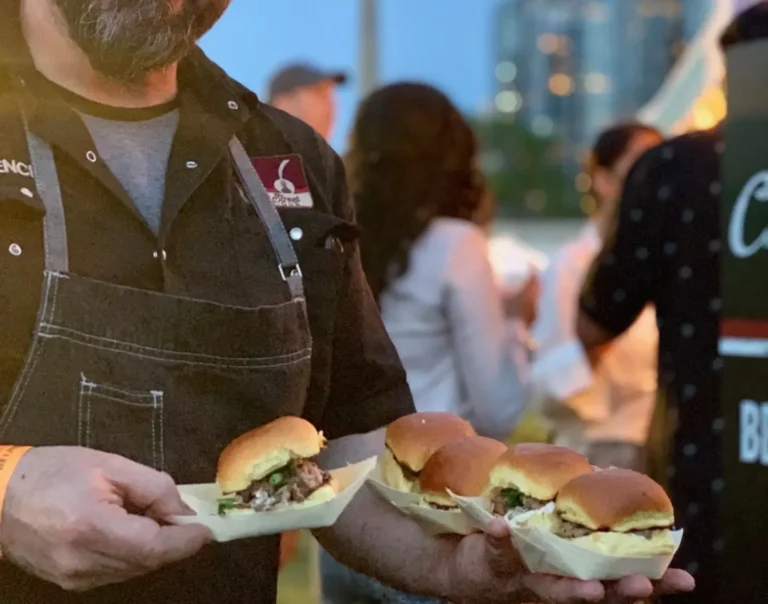
I asked seasoned pitmaster, chef and owner of Cherry St. Bar-B-Que, Lawrence La Pianta, for some tips to help with the great Canadian gusto for outdoor cooking. Turns out, there’s a lot to learn and he’s just the expert to set things straight. Enjoy!
H: Given your Italian background, where did your passion for barbequing start… do you have BBQ sauce in your veins?
Lawrence: My passion for barbeque actually came about because one of my best friends is Filipino. The first whole hog I ever cooked was in his backyard when we were in high school. That lechón was my first foray into live fire BBQ, which led to falling in love with live fire cooking.
There were different chatrooms back then (pre-Instagram) and we were in a forum called BBQ Brethren. People posted pictures and recipes and talked about places they visited and it quickly turned into something where I would book time off work and travel down South to visit all these storied BBQ places. Later, I went on to befriend a lot of these people and cook with them at festivals. I travelled extensively through the US and took classes down there.
Food has always been important in my life. Sunday dinners were a religion. You had to be home at 4 o’clock on Sundays for family dinner no matter where you were or what you were doing. Then guests would show up and the wine would start flowing – hosting and entertaining was a big part of what I grew up in.
H: What’s the difference between grilling and BBQ?
Lawrence: BBQ is the act of cooking low and slow over a period of time. Barbequing, as most Canadians refer to it, is when they’re putting a steak on a grill. That’s not barbequing, that’s grilling. Anything that’s hot and fast is grilling, high-temp cooking directly over the fire. Anything that’s cooked indirectly or offset at a lower temperature over a long period of time is BBQ. The vernacular is important. 😊
Obviously, you have to cook on hardwoods. If you’re doing a lot of high-temp cooking, alder and ash are very good because they’re dense and super dry and flavour neutral. They don’t really impose much on your food, except for that ember, charcoal flavour.
BBQ isn’t ingrained in the fabric of Canadian culture, it’s not what we’re known for. But the commonality that ties everyone together is the fact that it’s primal. Early man cooked on wood. People smell wood burning and it strikes a chord. It was the advent of cooking on fire that made us civilized. It’s a basic instinct and anything cooked on wood tastes better, I think.
H: Does travel inspire your cooking?
Lawrence: Absolutely. I think travel and understanding and respecting various cultures is important to grow as a person. I’ve been blessed to travel to multiple continents and enjoy different cooking techniques and tastes from around the world. I’ll often bring that back into my kitchen. At a resort, I’m the guy who avoids all the onsite restaurants and runs down the street to find whoever’s cooking on a wagon and try their food. I always eat where the locals eat.
In a previous life, I worked in television film production and often hosted directors and producers from the US. The thing I’m most proud of in Toronto is that we have every possible type of cuisine you could want, available at a high level where someone’s doing it very well. There’s a community for every part of the world here in Toronto.
H: Were you always BBQ savvy?
Lawrence: No. I’ll never forget the first brisket I cooked. It was atrocious, it tasted like a shoe. I went out and bought a tiny offset smoker that was on sale for half price – $99. I bought about a hundred dollars worth of wood and extras and it ended up being a $400 day. I had no concept or understanding of how to cook a brisket. I didn’t trim it, I didn’t season it, just threw it on and prayed that the fire would be hot enough to cook it. Eight hours in, I was thinking it’s got to be done… it looks like a meteorite, it’s so dark. So, I cut into it and tried to tell myself it tasted good. I choked down a couple bites and it was horrible. Anyone who tells you that the first time they cooked a brisket it was amazing is absolutely lying. Trust me, it takes a lot of trial and error to get good at it, and I’ve done thousands of hours.
H: How do you see the future of outdoor cooking?
Lawrence: “It continues to evolve as more new Canadians arrive in the country and bring different styles of cooking and we’re exposed to more opportunities to taste world flavours. That is high on my list and more so now it’s the fusion of those international flavours. I cook with a variety of spices from around the world and I’m trying to fuse a lot of Italian, which I know very well, with other world flavours. Once you have a good grasp of a specific flavour, marry it with something else that complements it. I think the future is the fusion of all these flavours, as we start creating more interesting, more dynamic dishes.
H: Let’s talk about your Cherry St. Bar-B-Que Sauce…
Lawrence: I’ve been running with this recipe, or a very similar one, since 2010. I’ve been tweaking it the whole time but the base has been a staple with me and with Cherry St. since the get-go. I’ve tried to design an all-purpose BBQ sauce, which has a beautiful balance of sweet, savoury and acidity so it can meld well with any of the proteins. Some people cut it with a little more maple syrup and brush it on their salmon. It has lots of versatility – it’s my secret weapon for cooking.
Some people thin it out to use as a mop or a marinade during the cook but if you use it straight from the can, you want to apply it in thin layers closer to the end of the cook because anything that has a high amount of sugar like BBQ sauce will start to burn and taste bitter if it’s put on too early. If you cook ribs slowly in a 5-to-6-hour method, the sauce should be applied only in the last hour, during the last 20 percent of the cook as a general rule of thumb.We’re super excited about our ‘very creatively packaged’ Cherry St. Bar-B-Que Sauce. It’s packaged in a 355 ml. short style beer can, so when you see it on the store shelf adjacent to other BBQ sauces it’s unbelievably unique. It opens just like a can of beer and comes with a resealable plastic cap so you can put it back in the fridge. To learn more,visit cherrystbbq.com.