Toronto Icon: Barberian’s Steak House
A family legacy of dining, wining and steak secrets
The year was 1959. Harry Barberian had been working for several years as manager-chef at Le Baron steakhouse but his appetite was stoked for change. So he bought a cottage at 7 Elm Street for $6,000 and founded his own restaurant – seizing the opportunity to share his love for a great steak with the city of Toronto.
Barberian’s Steak House became a crowd favourite and Harry was the life of the dining party. People came for the experience as much as the food. In those days a rib steak cost five dollars and there was no liquor, but that didn’t keep diners away. In 1969, an addition at the back of the building for the grill provided seating for more guests in the front dining room. In 2006, another dining room was added, plus a two-story subterranean wine cellar that is home to thousands of bottles and a world of envy.
Enter Harry’s son, Arron Barberian. Savvy businessman, wine aficionado and quite the character. We enjoyed conversing with this fascinating Torontonian, grilling him about the city, the family biz and his secrets to the perfect steak. The chat was unmistakably steeped in gratitude to his parents Helen and Harry, who taught him the importance of giving back.
Q: Toronto has really changed since Barberian’s Steak House opened – what are some of the biggest differences you’ve noticed?
A: Barberian’s is a very interesting business because we’ve established ourselves at such a level that it’s pretty static. So we don’t see the same fluctuations as other small restaurants would see. It takes a long time and it’s almost impossible for restaurants to do now what we’ve done over the years.
Toronto used to be a real late-night city. In the ‘60s and ‘70s, people were dining late into the night, that doesn’t happen anymore. Barberian’s used to close at 1 or 2 in the morning, now we take reservations only until midnight. Rarely do we see people much after 11 o’clock. Back then, our neighbourhood was surrounded by nightclubs and bars. The music scene was all here and often after the shows we’d be full. That’s all changed.
People today make TikTok videos or go on YouTube and that’s how they promote themselves. The years of Robbie Robertson or Neil Young or Gordie Lightfoot working the clubs around here are long gone. That’s had a major impact on the nightlife in Toronto. The city’s also very diverse. So what I might be seeing as a loss in my community may be strengthening in other parts of the city.
Q: What keeps long-time patrons and the next generation coming back to Barberian’s?
A: How about the next, next generation… the grandkids are coming now. That’s part of our core at Barberian’s – being a stable part of the fabric of this city. We haven’t changed a whole lot. Although, we do get a lot of requests for Halal steak, for example. The Muslim community has grown considerably in Toronto, so we can be here for them. We want people to celebrate and enjoy. We obviously have a meat-focused menu but we do our best to accommodate vegans, vegetarians and people with food allergies.
When my father first opened the restaurant, people literally ate in an hour. Barberian’s is almost three times the size it was then and we serve about the same number of customers because people dine longer. It’s an experience now. Part of that is the menu, part is the wine list – we have the largest wine list in the country. When people are potentially spending thousands of dollars on a bottle of wine, they want to relax and enjoy it.
Q: Speaking of vintages. Your wine cellar is absolutely amazing…
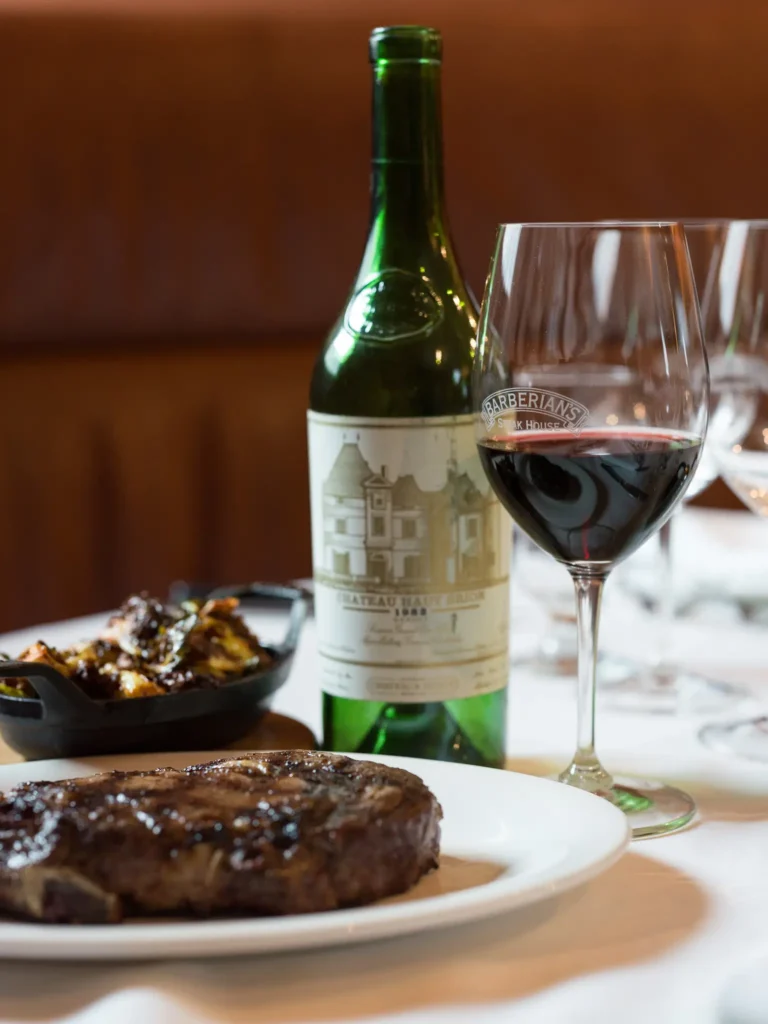
A: My favourite part of Barberian’s over the nearly 30 years that I’ve been running it on behalf of the family has been collecting the wine. The steak part is relatively easy, a lot of people can do that. Building the wine list we’ve built? Nearly impossible. Being able to create a massive wine cellar, to understand the various wines from different regions and build on that. In many cases, I’m getting the only six or eight or dozen bottles coming into Canada and being able to know when to put them on the list and not.
Sometimes wine makers will come see me and say, “Arron, we’ve sold you wine for the last three years, where is it?” And I tell them, they’re not ready to drink, so they’re being stored. Just because we bought it doesn’t mean it’s on the list. Right now, the list has about 4,000 selections on it – that’s only about 60 percent of what we have. The other 40 percent is being slowly stored until it’s ready for the list.
I’ve always been a wine enthusiast. I spent almost a year of my life in France, alone, just tasting. At Barberian’s, we give people a more expansive, more pleasurable wine experience. We have the largest wine cellar in the country, bar none. We’ve had some great wine directors and sommeliers at the restaurant. We encourage that program and help send sommeliers to world competitions.
Q: What was it like growing up in the restaurant business?
A: I’m a very privileged kid. My father started in the restaurant business early and became very successful – bought a Rolls Royce at the age of 31. But he worked too hard and eventually sold Barberian’s in the mid-70s and we moved to Florida.
I always loved the business. As a six-year old, I’d wake up every night around 2:30 and sit at the top of the stairs waiting for my father to come home. I’d ask him what famous person came in or how many covers he did, and we’d have our little business meeting and I’d have a sip of water and he’d tuck me back into bed. That was my growing up life. Florida was great. I had a boat at the age of 12 and I’d go fishing every day before school but I knew I wanted to get back into the restaurant business. When we got a chance almost 30 years ago to buy back Barberian’s from the partners, we returned to Toronto and decided to build the restaurant back to what it was. It was great to come back.
Q: Toronto has truly benefited from the Barberian family. How have you been involved?
A: When we moved back from Florida, the city was kind of on the decline. That’s when I came up with the idea to build Yonge-Dundas Square and convinced city council that we needed this outdoor public and event space. I was just 28 years old and used my own savings to put up the original $10,000 seed money to hire the consultant.
Giving is the hallmark of our family. I feel privileged to have this business, people believe in us and they celebrate all their great moments and their sad moments here at the restaurant, so the giving part is most important. Whether it’s Holland Bloorview or Mount Sinai Hospital or a hundred other charities, the odds are that you’ll find us there helping. We’ve donated and raised hundreds of thousands of dollars for the Jays Care Foundation to help make wheelchair accessible parks.
My dad died 22 years ago and I think he’d be very proud of what we’ve done. My mother, Helen, calls to remind me every day that she thinks I’m doing good. She can’t believe that people know us and I say, “Mom, we’re the oldest white table restaurant in Toronto and we’ve been a big part of people’s lives.”
Q: What else would you like to share about Barberian’s Steak House?
A: “Every famous person you can imagine has been to Barberian’s. I’m happy to have met a lot of my heroes – a lot I’d like to see again if they were still alive. I had dinner with David Bowie many times… But you can’t look back, you always have to look forward. I look forward to the next superstar!”
ARRON’S SECRETS FOR THE PERFECT STEAK
- Obviously aging is important. As the meat slowly breaks down and ages over a month or two, there is an intensification of flavours and it’s definitely more tender when cooked.
- We use hardwood charcoal. We like the effect – it leaves little crispy bits and extra Maillard. (*The Maillard reaction is a series of chemical processes responsible for the golden-brown colour and crust that forms on well-grilled meat.) Thickness matters too, they have to be appropriately thick. Of course, we use our Barberian Steak Seasoning. It’s a ‘nice little recipe’ and we’ve sold millions of bottles since the 1950s.
- The next trick is to let the steak rest. In my opinion, it should rest longer than it cooks. So if you cook it for 10 minutes, let it rest for 12. The juices will go back into the meat and it will be much more enjoyable.
- The last, most important thing is a very, very sharp steak knife. You judge tenderness not in the mouth, you judge tenderness in the hand. When you’re cutting the steak is when you decide whether it’s tender or not. I don’t believe in serrated steak knives, so our knives have a very plain edge and they’re sharpened once a week. That’s the final trick – a very sharp knife.